
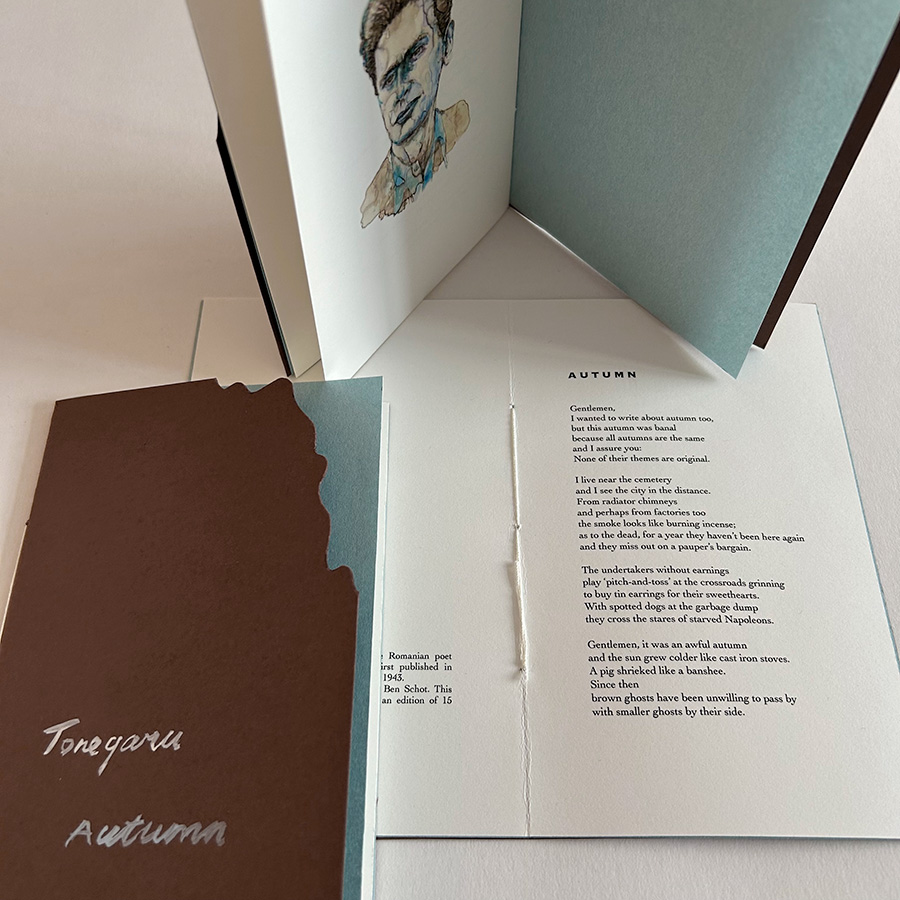
 New hand made Sea Urchin pamphlet:
Like his friends Dimitrie Stelaru and Geo Dumitrescu, Constant Tonegaru (1919-1952) belonged to the line of Romanian Francophile symbolist poets, who took inspiration from the French avant-garde and their 19th-century predecessors. Opposing Romania’s rising nationalism and fascism, their short-lived literary magazine Albatros was shut down by wartime dictator Ion Antonescu in 1942. Despite the repression by the authorities, Tonegaru’s first and only compilation Plantații (Plantations) was published in 1945. Two years earlier his poem Toamnă (Autumn) had been published in the renowned Bucharest magazine Preocupări literare. An English translation of that poem has now been published by Sea Urchin. Autumn is typical of Tonegaru’s highly individual poetry of the period with influences of 19th-century Symbolism and 20th-century Surrealism. Tonegaru starts his poem with the line: “Gentlemen, I wanted to write about autumn too” as if referring to Baudelaire’s Chant d’Automne (1861) and the ‘autumnal poet’ George Bacovia, who belonged to an older generation of Romanian Symbolists. At the same time embracing and rejecting the worn theme of autumn, Tonegaru continues to write an original poem on the subject, larded with surreal images of street life in Bucharest during World War II. Read more →