



Poet: Sinclair Beiles
Publisher: Cold Turkey Press, Rotterdam
Year: 1975
Size: 293 x 206 x 7 mm
Pages: 90, mimeographed & saddle-stitched
Language: English
Design: Cold Turkey Press
Edition of 250. This copy is rubber stamped and hand numbered 53/250
Condition: fine. The original spine tape has retracted a bit over the years.
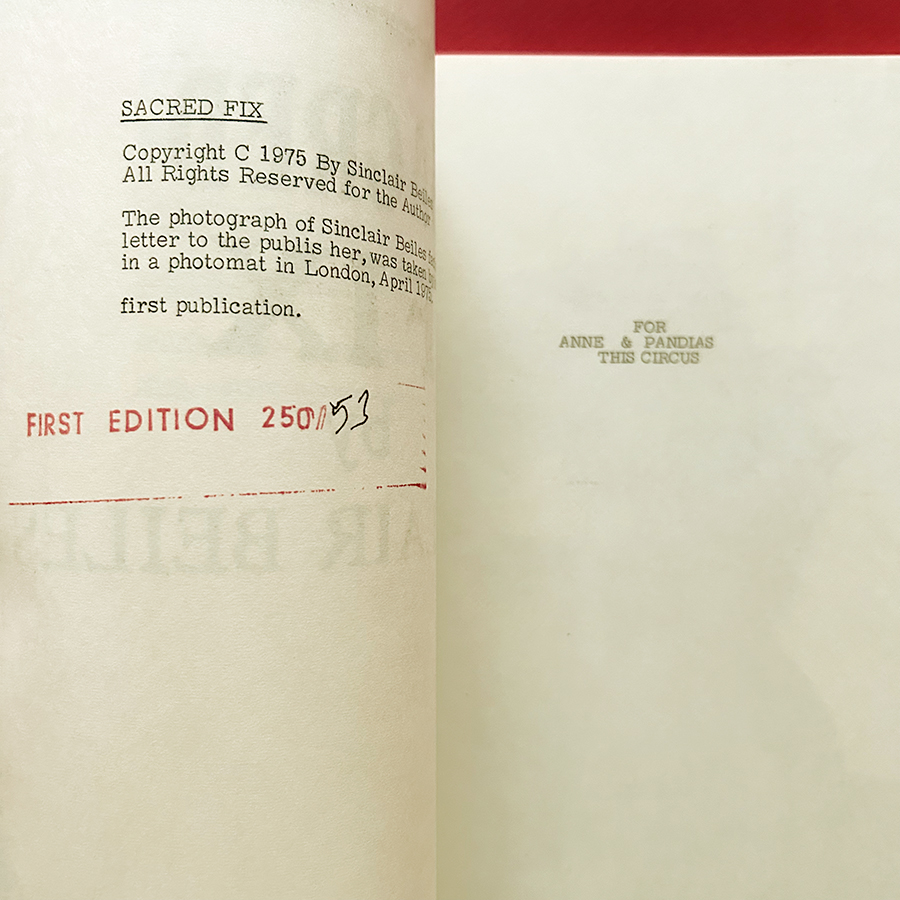
By SACRED FIX I mean the fix on and with Madness – that sanctified condition when all has meaning and the madman is a poet living a poem. Apart from LEAR IN LOS ANGELES, I have enclosed ‘The Needle Vestal’, ‘The Rake’s New Progress’… all of which were written either in asylums or when I was under psychiatric supervision. Indeed these have been the conditions in which most of poetry has been written. In many ways the conditions of an asylum are ideal for a poet, for he is surrounded by other madmen subject to all kinds of poetic visions and hallucinations. The vibes are right. Also he has a highly sympathetic audience in his fellow madmen.
(Sinclair Beiles in a letter to the publisher)
Sinclair Beiles was born in Kampala, Uganda in 1930, the only child of Jewish South African parents of Russian descent. The family moved back to Johannesburg when young Sinclair was six years old. There he studied at Wits University before starting a wandering existence in the early 1950s. Beiles travelled to New Zealand, Spain and Tangier, where he first met William Burroughs at Dutch Tony’s male brothel in 1954. Some five years later he ran into Burroughs again. This time in Paris, where Beiles worked as a writer and editor for Maurice Girodias’s notorious Olympia Press. Beiles secured Burroughs’s manuscript of Naked Lunch for his employer and guided the work to its publication in 1959. At the request of Burroughs, Beiles took up lodging at the Beat Hotel the following year, where he co-authored the seminal cut-up pamphlet Minutes To Go with Burroughs, Gregory Corso and Brion Gysin. When the original Beat Hotel scene dissolved in the late 1960s, Beiles left Paris and travelled to Greece and England before finally returning to South Africa in the late 1970s.
Sinclair Beiles, who “ran through psychiatrists like boxes of Kleenex” according to Heathcote Williams, suffered from bouts of mental illness and was admitted to various institutions during his lifetime. Beiles himself maintained that his brain had become unhinged in 1962 after having been part of one of Takis’s sculptures, in which a powerful magnetic field had kept him suspended in mid-air while he proclaimed a poetic manifesto. Whatever the cause, Beiles’s fragile mental condition played an important part in his life, much of which was spent in institutions, and in his work, much of which was written under the influence of prescribed and unprescribed drugs. Beiles, the first poet in space, the madman who had nailed carrots to the car of a member of the Greek junta, died virtually unknown and penniless in Johannesburg in 2000.