
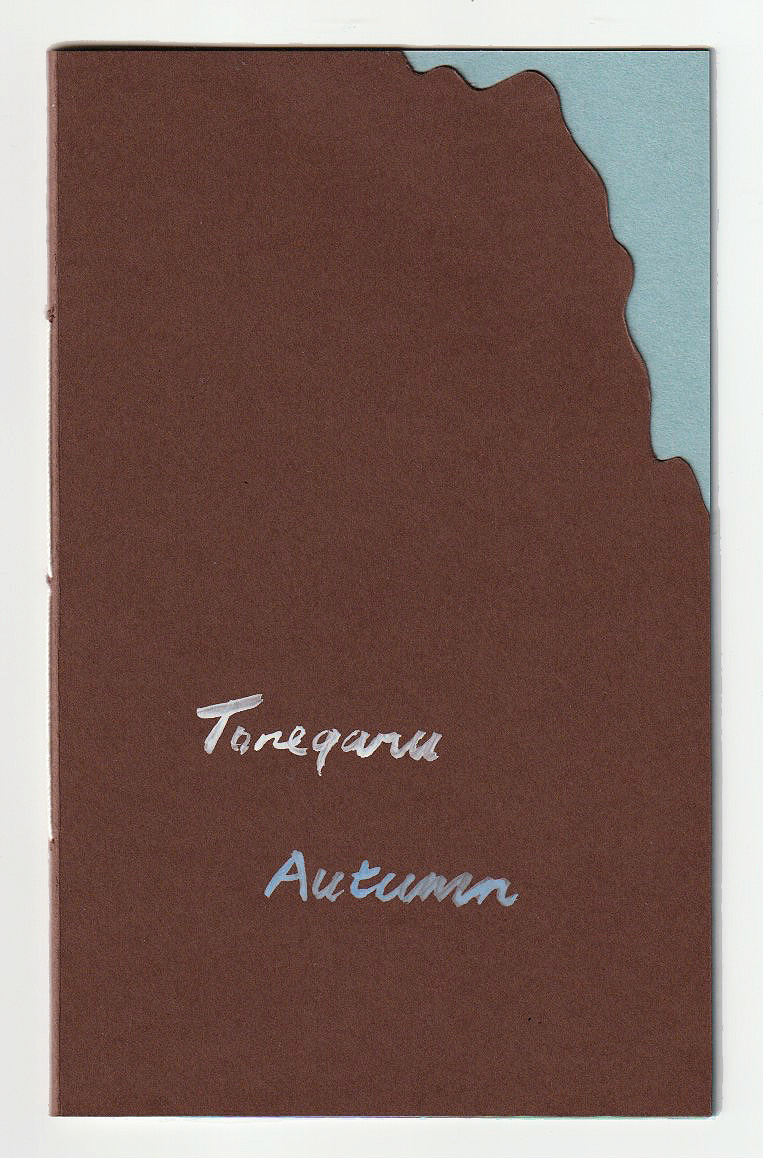


Poet: Constant Tonegaru
Publisher: Sea Urchin, Rotterdam
Year: 2026
Size: 180 x 111 x 3 mm
Pages: 4 pamphlet stitched pages
Language: English
Translation, artwork & design: Ben Schot
Hand numbered edition of 15 copies
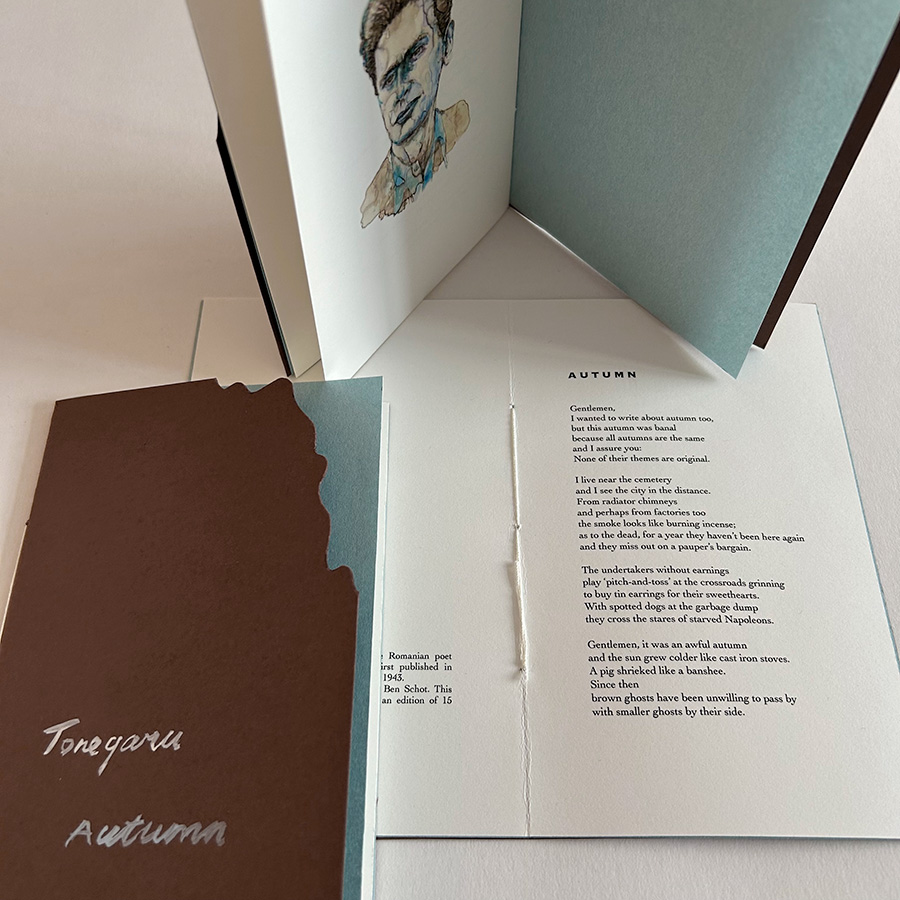
Constant Tonegaru was born into a middle-class family from Galați, Romania in 1919. His father was a ship captain, who took his son on voyages to Greece, Turkey and Egypt and instilled him with a passion for poetry. After having finished primary school in Brăila, Tonegaru moved to Bucharest where he finished his secondary education and was trained as a journalist. His first articles were published when he was only 17 years old. Two years later, however, his life took a dramatic turn when his father was convicted and imprisoned for a crime of passion. Constant was suddenly charged with the care of his mother and from 1939 and 1943 had to do jobs for the Romanian Railway Company and the Romanian Post in Bucharest to provide for his mother’s and his own livelihood. In those days he befriended the bohemian circle of poets who hung out at the café’s of Bucharest’s Gara de Nord district, among whom Dimitrie Stelaru, Geo Dumitrescu, Ion Caraion, who would later be labelled Romania’s ‘Lost Generation’ of poets.
Like his friends, Constant Tonegaru belonged to the line of Romanian Francophile symbolist poets, who took inspiration from the French avant-garde and their 19th-century predecessors. Opposing Romania’s rising nationalism and fascism, their short-lived literary magazine Albatros was shut down by wartime dictator Ion Antonescu in 1942. Despite the repression by the authorities, Tonegaru’s first and only compilation Plantații (Plantations) was published in 1945. Two years earlier his poem Toamnă (Autumn) had been published in the renowned Bucharest magazine Preocupări literare. An English translation of that poem has now been published by Sea Urchin. Autumn is typical of Tonegaru’s highly individual poetry of the period with influences of 19th-century Symbolism and 20th-century Surrealism. Tonegaru starts his poem with the line: “Gentlemen, I wanted to write about autumn too” as if referring to Baudelaire’s Chant d’Automne (1861) and the ‘autumnal poet’ George Bacovia, who belonged to an older generation of Romanian Symbolists. At the same time embracing and rejecting the worn theme of autumn, Tonegaru continues to write an original poem on the subject, larded with surreal images of street life in Bucharest during World War II.
Constant Tonegaru not only opposed fascism, militarism and nationalism when Romania fell under a fascist dictatorship during the war, but also actively opposed the communists once they had taken control of the country after the war. He was arrested by the secret police, the hated Securitate, in 1949 and was convicted to two years’ imprisonment. Already suffering from a heart disease, Tonegaru was unable to cope with the harsh conditions in his cell. He fell ill and was only released when the regime realised that he was dying from a lung disease and didn’t want to be blamed for having killed him. Constant Tonegaru died three months later, aged 32.