
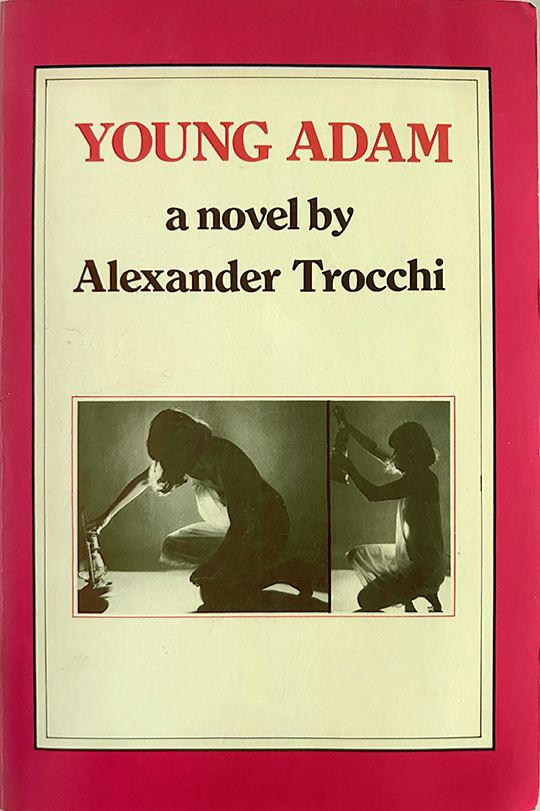
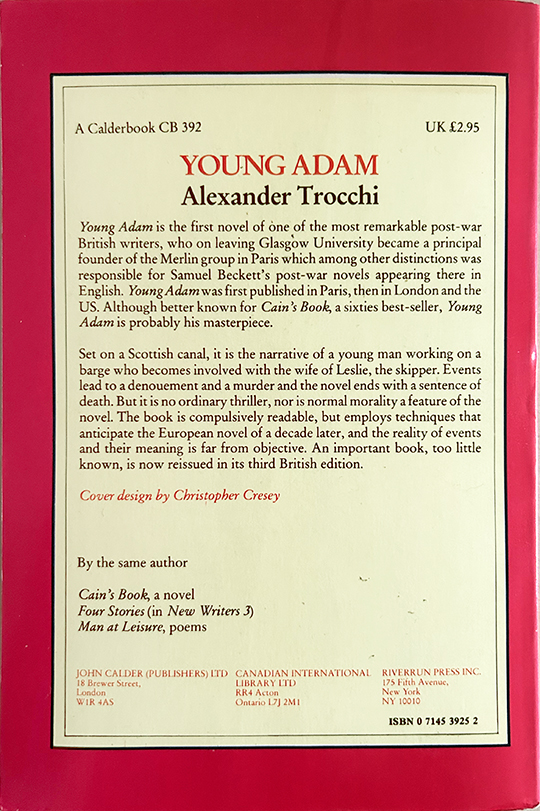

Author: Alexander Trocchi
Publisher: John Calder, London/Riverrun Press, New York
Year: 1983, first printing
Originally published by Olympia Press, Paris, 1954
Size: 195 x 130 x 8 mm
Pages: 160, softcover
Language: English
Cover design: Christopher Cresey
Condition: Good. Some discolouring of spine and pages.
Scottish novelist Alexander Trocchi co-founded and edited the English literary magazine Merlin in Paris from 1952 to 1954. Merlin was pivotal in making works by Samuel Beckett, Jean-Paul Sartre a.o. available in English. After the magazine had folded, Trocchi got addicted to heroin and wrote a string of pornographic books for Maurice Girodias’s Olympia Press to sustain himself and feed his addiction. Young Adam, although spiced up with erotic scenes at the request of Girodias, is Trocchi’s first serious novel. The book was published by Olympia Press under the pseudonym Frances Lengel in 1954. Young Adam is an existentialist novel, set on a barge on the Edinburgh-Glasgow canal, with a plot that develops antichronologically and a style and theme that are reminiscent of Albert Camus’s l’Étranger.
Trocchi’s restless existence took him from Glasgow, where he was born in 1925, first to Paris and from there to California, New Mexico, New York, Montreal, and London. Connected to both the Beats in the US and the Lettrists in France, he formed one of the early links between the Beat Generation and the European avant-garde. In New York, where he worked on a stone scow on the Hudson River to make a living, he wrote his autobiographical second novel Cain’s Book, which was banned in the UK in 1964 for the junky lifestyle it portrays. Candid descriptions of the existential bleakness of junky life combined with Trocchi’s refined writing style make the book a classic of post-war literature.
Trocchi moved to London in 1962 and stayed there until his death in 1984. He never managed to finish another novel but continued to publish works under the cloak of his Project Sigma, which was related to Situationist International. The best-known of these works is the 1963 manifesto A Revolutionary Proposal: Invisible Insurrection of a Million Minds, which – via Simon Vinkenoog – influenced Provo in Amsterdam.
The condition of this copy of Calder/Riverrun’s 1983 reprint of Young Adam is good, with some discolouring of the spine and the pages.